Q1. What is data security in the age of agentic AI?
Data security in the age of agentic AI means preventing sensitive data from being accessed, moved, or exposed by AI-driven actions. As AI agents query internal systems and send outputs to LLMs and external services, they can unintentionally export confidential information beyond organizational boundaries if governance and guardrails are incomplete. This gap is often unintentional and invisible: it can stem from unclear agent permissions, missing policy enforcement, limited visibility into agent behavior, or insufficient AI literacy, not necessarily malicious actions. Traditional, human-centered review processes struggle to keep pace with high-volume, fast-moving agent activity.
Q2. How is AI adoption evolving in organizations?
AI adoption is accelerating, with many enterprises moving from experimentation to agent-based automation. Adoption is happening both through formal programs and informal usage, driven by productivity gains and business impact. At the same time, regulated industries and security-conscious teams are taking a measured approach as they balance investment costs, skills gaps, and governance requirements while defining their AI strategy. Autonomous AI agents are racing into the enterprise, transforming AI from a source of information and insights into a system that can do real work, with 85% of companies expecting to customize agents to fit the unique needs of their business [5]. That said, only 25% of enterprise organizations have autonomous AI agents in pilot phase, 13% in moderate, and 6% in full scale deployment [5]. Unsanctioned AI agents appear early in adoption, with 54% of organizations reporting 1 to 100 unsanctioned AI agents, even when overall agent counts remain relatively modest [1].
Q3. What key data-security challenges do enterprises face as they adopt AI?
The biggest data-security challenge in AI adoption is knowing what sensitive data exists, where it lives, and how it is being used, especially in unstructured content. Many organizations struggle with accurate identification and classification as well as automation at scale, which makes it harder to apply consistent protections. Most (75%) organizations describe themselves as moderately or highly confident in their ability to secure data [3]. However, most (68%) organizations also report a significant portion of their unstructured data remains unprotected [3]. Many (36%) organizations cite lack of automation as a challenge when scaling their data security. Advanced, AI-driven threats were the most-identified (47%) top security risk to unstructured data in 2026 [3].
Q4. What are the key challenges enterprises face with AI security?
AI security becomes harder when systems gain autonomy and integrate with business workflows. As AI deployments expand in scope, misalign with intended functionality, or introduce new data privacy risks, the attack surface grows, making incidents more likely and harder to contain. AI agent-related incidents are common, with 65% reporting at least one in the past year [2]. Scope violations are routine rather than exceptional, with 53% of organizations reporting that AI agents exceed intended permissions occasionally or sometimes [1]. Security incidents have tangible business impacts, including data exposure (61%) and operational disruption (43%) [2]. The majority of AI leaders consider risk and compliance as a top challenge for agentic AI adoption [6].
Q5. What key challenges do organizations face with AI governance?
AI governance breaks down when ownership, standardization, and real-time oversight do not scale with adoption. While most organizations recognize the risks and the need for strong governance, they face barriers such as limited skilled staff, review fatigue, and manual processes. Many also lack a centralized platform, clear ownership for each agent, and an emergency kill switch to pause or disable agents during incidents. Only 5% use a single agentic platform, while 44% use two to three platforms and 43% use four or more [1]. Ownership is often unclear as well. Only 15% report that 76 to 100% of agents have defined ownership, while the most common ownership range is 26 to 50% (34%) [1]. Monitoring is also largely periodic (59%), reinforcing a governance model based on checkpoints and escalation [2]. Only 21% have formal decommissioning processes, and just 19% express high confidence that they fully retire their agents [2].
Q6. What is the impact of AI on compliance in regulated industries?
In regulated industries, AI adoption increases compliance pressure because existing frameworks (privacy, security, records, auditability) still apply, and AI agents can introduce new control and documentation gaps. Even so, only 13% of organizations report feeling highly prepared for upcoming AI-related regulations [1].
Q7. How are enterprises addressing AI adoption challenges and security risks?
Most organizations are starting cautiously by piloting lower-risk agentic AI use cases with heavy human monitoring. In practice, governance often relies on checkpoints and reviews, while teams mature their risk management, permissioning, and monitoring capabilities. Only 30% say they are highly prepared and 42% say moderately prepared for AI risk and governance, even as they prepare for higher AI adoption [7]. Organizations are prioritizing monitoring, risk management, and permission control [2]. They are converging on action risk and human authorization as the primary signals for governing agent behavior. Nearly 79% view context-aware controls as important or very important, and 66% report clear guardrails defining agent boundaries [2].
Q8. How does SmartVerify help with data security in the AI era?
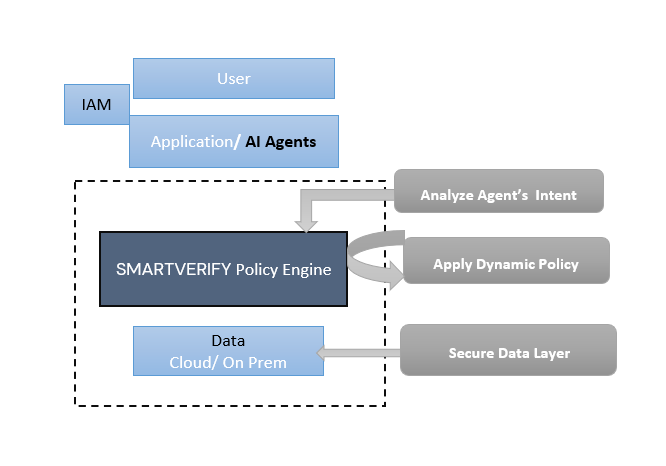
SmartVerify sits on the connection between AI agents and data. It records the statement as executed, rows returned, columns read, session and agent identity. The Platform coverage grid lists current source and control availability.